

The theme for this game jam was to make a sandbox game around an uncommon verb, for my team of 6, that was plunging. We shared many roles on this project and the ones I focused on were game design, 3D art and level design.
Below is a breakdown of each of the 5 days of the project.
Day 1. Ideation & Meeting the Team
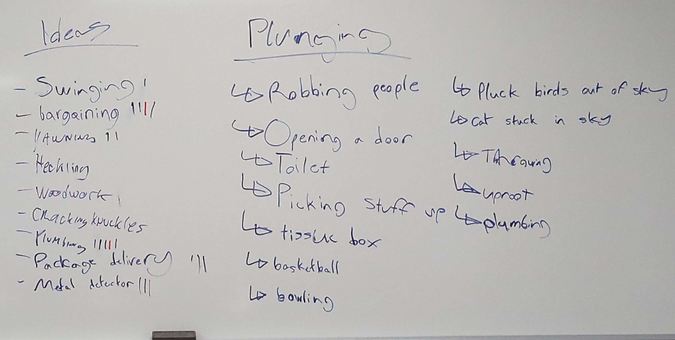
Day 1 of the game jam was focused on meeting the team I would be working with and deciding on a direction to take our game. We began by brainstorming a bunch of different ideas and decided on three to investigate via a vote. Our next step was to draw out some mechanics for these ideas.
Day 2. Deciding on Direction
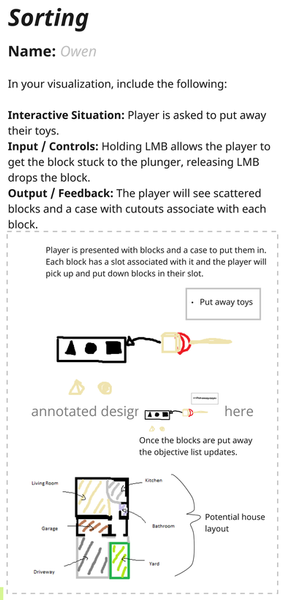
The next day we needed to decide on a verb for our game. We had some solid ideas but we needed to come together and find which idea had the most legs. We decided on plunging as the verb and began brainstorming what we could do with this verb. Additionally we began the alpha stages of our Unreal Engine 5 build. I explored a sorting puzzle where players would need to find certain shaped blocks in a play room to be put away, thereby cleaning up the space. Additionally, I started designing room house layouts for our sandbox level.




Day 3. Planning and Production Starts
The third day is when production really kicked off. We decided the core of our game focused on the aesthetics of using a plunger on objects in new and interesting ways. We began listing out affordances for our environmental interactions and creating prioritizations for each of our desired interactions. Additionally, I worked with our other level designer on the order of the beats we wanted the player to experience via a spatial diagram. At this point as part of the art team we started creating some top priority assets and assembled some free-use online assets to accompany.

Day 4. Playtest & Polish
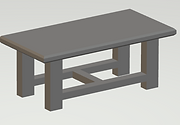
Day 4 was playtest and polish! On this day we had a greyboxed build ready to be explored so we ran a few playtests and learned a few things. Metrics needed to be adjusted a little bit and the movement of the player felt too fast for some players. After those quick fixes we got to work on the final touches. Because day 5 is the presentation of the game we needed to finish as much as we could, so our team worked hard starting at 9:00am and finishing at 1:00am. During this push to polish I focused on getting the art side of the game finished with our other artist. That included helping design and create 3D assets and teaching one of our less experienced members how to do some basic lighting in Unreal.




Day 5. Present
The final day was when we presented our game to the staff and all our peers, and it was really fun! Every group got to see and play all the other projects and I finally got some non-work time to spend with my team. This is where we also added some additional extrinsic motivation for our players. We ended up having to cut the "to-do" list that we had planned due to time constraints so we made a physical to do list instead! We made small plumbing invoices with tasks to be accomplished and once the player finished the job someone from our team handed them their receipt. It was a really fun addition to the game and made our booth a lot more attractive to the people on the floor!


Final Thoughts
The good:
- Team synergy was on point! We had great communication and every member helped teach one another and support other disciplines if needed.
- The goal of having a semi-cartoony aesthetic to the game was achieved and received positive feedback from players.
- The level was easily explored by players.
The less good:
- Due to some poor planning for the scope of our project we had to simplify and cut some of our core beats for the game.
- There was not a lot of structure to gameplay and players needed external guidance.
- The sound design was repetitive and jarring for many players.
Lessons:
- Having all members on the same vision for the game is essential for saving time and keeping Mechanics, Dynamics and Aesthetics consistent with one another (especially in a weeklong project).
- Planning a smaller, more easily implemented feature can be a lot more effective on tight deadlines.
- The games goals should be intrinsically tied to the actions players take within the game.