


Build your ship and fly through the skies in Cloudbound as you explore the world, fight off catastrophes, and right wrongs of your own doing! This is a 2D Co-op shipbuilding and adventure game created with Unity.
This game was made by an 8-person team as our capstone project for Sheridan College's Honours Bachelor's of Game Design program. My roles on this project were Game Designer, Level Designer, Project Manager and Audio Designer.

Production on this game happened over our final 2 semesters (8 months) of our final year in the game design program. After that time, we took the project to LevelUp 2025, where we put it on display for the showroom floor.
Prework

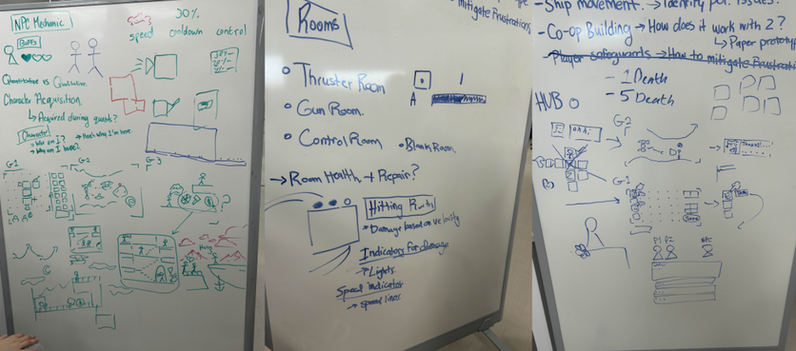
At this stage, we really just tried to nail down what our idea actually was. This took a couple of weeks for us, and we had a hard time agreeing upon a concept. Eventually, we started to iron out some core pillars and ideas that made up the game's vision.
The Game pillars we decided on are Chaotic Cooperation, Strategic Risk Planning and Player Agency.

Early Level Designs and One-Page Design
At this early stage, I took on two big tasks: creating a one-page design document for the main mechanics and creating two proof-of-concept levels. Within two weeks, I created the framework for our build and flying systems and built out two different levels.

This is my initial one-page design for the game's core mechanics. These mechanics largely stayed the same through production, but we added more systems around them to enhance the experience. The goal of this was to have each team member understand the basics of what the game vision was.

Proof of Concept
At this stage, it was all hands on deck, getting everything in a preliminary build to see if the game concept worked. I mainly worked on getting my level designs working as intended, but I also programmed the dialogue system so our narrative designer could begin putting conversations in our game.
Alpha
Heading towards alpha, I was now in charge of producing 1 of our main levels and our enemy designs for the game. To do this, I did a lot of playtesting for our game, and I even created a Telemetry Server for tracking data like where the most travelled areas are. All the playtesting conducted by my peers and me was what informed my level design decisions and the enemies.
Here is my first design for one of our final levels. Narratively, the players needed to collect food for a blimp that they were using to escape the flying pig enemies. I used the Crystal level from proof of concept as a base for this level because that level's open style allowed players to explore and take on challenges as they choose.


Work For the Final Build

During the final stretch, I had three main focuses: the "paralogue" levels, which were supplementary content focused on gameplay, adding in the audio for our game and designing the traps which would go into our levels to spice up the moment-to-moment gameplay.

These two paralogue levels were designed, greyboxed and created by me. I was given a 3-5 sentence explanation of their narrative wrapper and the instruction that these both need to reuse mechanics from our mainline levels. Because these levels show up later in the game, they include all the mechanics the game has to offer.

Final thoughts

I had an absolute blast on Cloudbound, and I'm very proud of my team and how much they've done. I learned A LOT on this project too. Specifically, when it comes to the management of the game vision and communication. There were many times on this project when I would pitch mechanics or ideas, and they would be shot down while leaving me confused as to why. Turns out each member of the team had a different idea of what the game was at its core. I learned you really need to anchor ideas on the core pillars you set for the game to keep the vision aligned. Then, whenever you are having discussions or making decisions, look back and ask the question, "Does this really align with the core experience we're set on creating?" This would have saved us a lot of time, and I'm glad I learned my lesson from this project.

